
Erasmus+ in kindergarten
Kindergarten Blauwe Poort in Kortrijk does everything in its power to keep our beloved planet healthy. With bicycle campaigns, reusable drinking bottles and lunch boxes, more and more greenery in the playground, and so on. ‘Whats learned in the cradle lasts till the tomb’, says teacher Caroline. ‘The habit of taking a reusable bottle with you is being ingrained forever.’
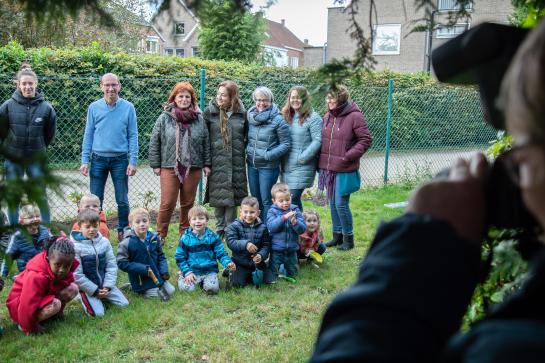
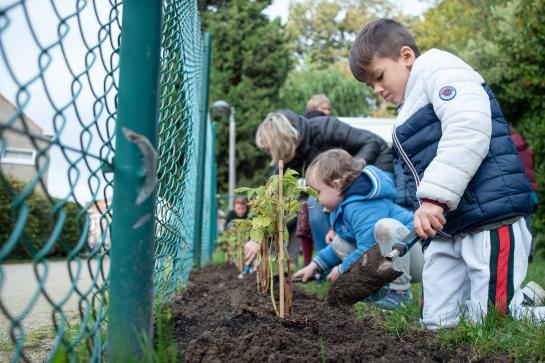
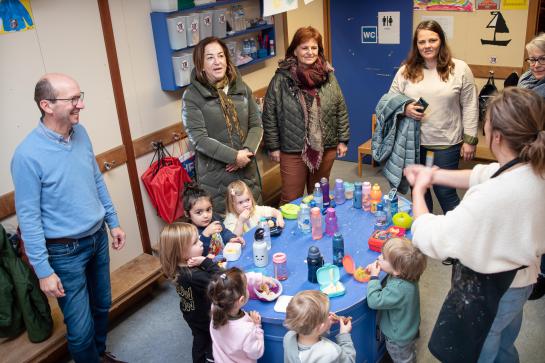
In addition to a few planters, the school has reserved a piece of open ground for berry bushes. Shovels are handed out and instructions given. 'Let's dig,' Herwig De Praitere, the school's director calls out. Blackberries, raspberries, redcurrants and whitecurrants go into the ground.
‘What's your name?’, a teacher asks a hard-working toddler. The boy looks up questioningly at the teacher. Herwig helps to translate and asks the toddler what his name is. ‘Stan', the toddler replies, a tad shyly. 'I'm Mojca', the teacher answers, laughing.
'Mojca is visiting, all the way from Slovenia', Herwig explains.
Kalimèra! Dober Dan!
Kalimèra, is the sudden sound between the children at lunchtime. And Ti kanete? How are you? The children quickly learn a few words of Greek. The international visit consists of a director and a teacher from Cyprus and kindergarten teachers from Slovenia. They are taking part in an Erasmus+ project to exchange experiences about the approach and the teaching in kindergarten.
‘We are the only nursery school in Cyprus that is participating in an Erasmus+ project,’ says Melina Louca, the director of the school from Cyprus. ‘It is interesting to see the differences and similarities in our approach.’
Kindergarten teacher Mojca Krajšek from Slovenia adds: 'In the end the goal is the same, we want to give our kids a smooth start and send them out into the world with an open mind,’ she says. ‘The way in which you achieve this, however, can differ, and that is precisely why an exchange is so inspiring.’
The idea for this project started at a seminar in Antwerp. It was there that director Herwig met a fellow principal from Slovenia. Not much later, other schools were sought to exchange with. Today, the delegation is in Kortrijk. Next year, it is Cyprus' turn, followed by Slovenia. ‘I am very curious about the school in Slovenia', admits Herwig. ‘It is located in the middle of the forest, so obviously the connection with nature is made in a very different way.’
Bicycle baptism in the centre of Kortrijk
Herwig has hired bicycles for his visitors to travel within the city. ‘After all, it is also a cultural exchange,' he says. ‘It had been 35 years since I had been on a bicycle,' says director Melina from Cyprus. 'Herwig took us straight to the city, instead of making us practise on an open field first!' she continues with a healthy dose of self-mockery. ‘In Cyprus, you put the bike on the car, drive to a quiet road where you can cycle at ease.'
Initially, a Latvian, Lithuanian and a Swedish school were also involved in the exchange. But due to the cancellation by the project leader in Latvia, the illness of the Lithuanian colleague and reluctance of the Swedish school, these partners have dropped out', says Herwig. A pity, according to the director, 'because in this way we would have had a nice cultural spread on a European level'.
‘The administrative part of realising this exchange demanded a lot of time,' says Mojca from Slovenia. ‘And the language barrier is also challenging', adds Melina from Cyprus. 'In nursery education, we don't usually use much English, so it took some refreshing.' Fortunately, Herwig and the teaching team act as interpreters between the international visitors and the pre-schoolers. 'Sign language also goes a long way, especially with such a young group', says Mojca from Slovenia.
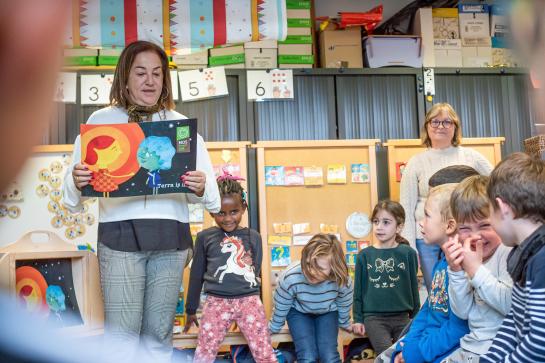
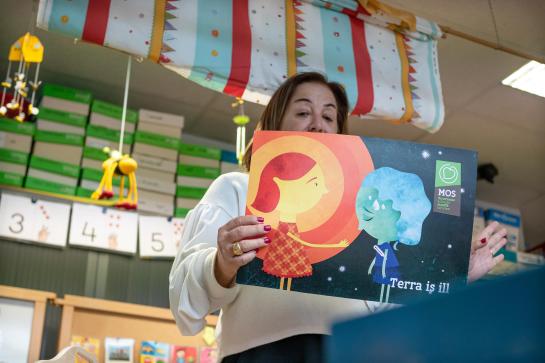
Terra says more than a thousand words
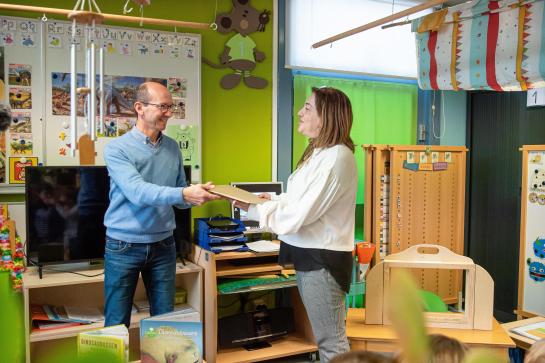
Despite the language barrier a visual kaMOShibai story like 'Terra is ill' creates a connection. The drawings speak for themselves. On the last day of the visit the English version of the story is handed over to the colleagues from Cyprus and Slovenia.
'It is a nice steppingstone for many learning objectives', says Mojca from Slovenia. And I am so grateful that I can take home concrete tools like those kaMOShibai drawings.
Cyprus and Slovenia are also working on the SDGs and climate goals. The goal is for preschoolers to make a difference through small actions. 'For example by switching off the lights or not wasting food', Mojca concludes.
'The children learn to understand that we always leave traces,' adds Melina from Cyprus. 'This is an important insight: as human beings, we have an impact on nature, the environment and the climate and we have to minimise this impact.'
Mushrooms in the classroom
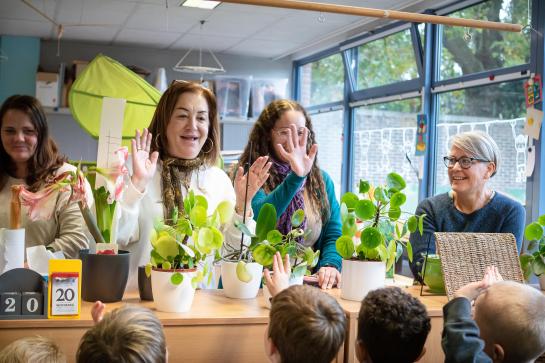
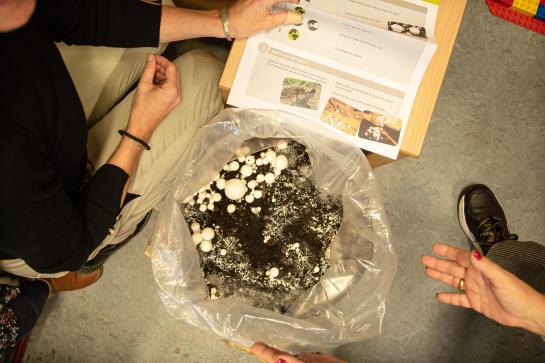
In the second kindergarten classroom, right in the middle, there is a large bag of soil. A while ago, mushroom spores were sprinkled in it, today edible mushrooms are growing there. 'How creative to bring nature into the classroom this way,' says Melina in amazement, 'we will take this idea with us to Cyprus.'
Besides the mushroom idea and a copy of Terra is Ill, the international visitors take home a lot more. 'I find it inspiring to see that the city council of Kortrijk and other local organisations are so closely involved in the functioning of the school', says Mojca from Slovenia. 'The power of a good story is also striking', adds Melina from Cyprus. 'It is nice to see how this young target group suddenly empathises with an abstract theme such as climate.'
The experiences of the exchange will be summarised in Greek, Slovenian, English and Dutch on the website 'Each Act Rises The Hope - E.A.R.T.H. During the visit to the schools in Kortrijk, the central theme was 'Seasons and climate'. In 2022-2023, the theme is 'Local Food'.
A report by Always Hungry and Lander Deweer (2022)
The school’s information
GBS Kindergarten Blauwe Poort
Halenplein 11
8500 Kortrijk
-
-
-
-
-
-
-
-
-
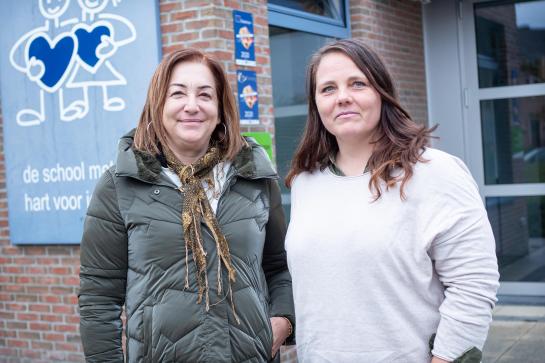 Mojca Krajšek (Slovenië) en Melina Louca Angelopoulou (Cyprus)
 -
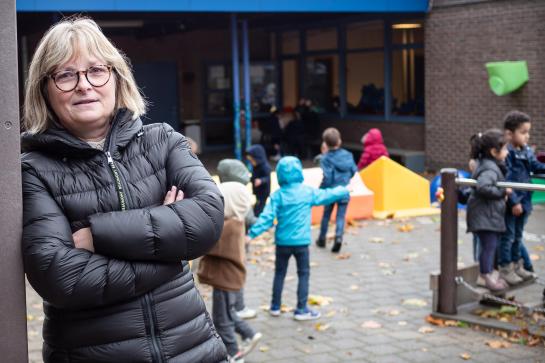 juf Caroline Van Biervliet


