

Ant meets Worm. He/she lives underground and emerges from a pile of earth when it rains. That's why they call him/her also “Earthworm”. But now it's not raining. His/her friend Mole Cricket is sick. Earthworm wants to know what's going on. Ant wants to help him. He recognizes the strange smell. Some people spray junk because they don't want some plants in their garden. That’s why Mole Cricket has a stomach-ache. Ant suggests moving. And that helps!
Theme: soil life and man’s impact
Sub-themes: healthy soil, small animals, soil pollution, illness, friendship
- International Biodiversity Day (May 22).
- A school garden or vegetable garden is being constructed at school.
- This story can be used as an introduction to lay out a school (vegetable) garden.
- How can we ensure that animals such as Worm and Ant feel good while we are constructing our garden?
- How can we ensure that the soil in our garden remains healthy? (e.g. by using compost as fertilizer, no pesticides, …)
- How do we deal with possible plagues and diseases? (e.g. natural repellents such as nettle vulture, attracting birds, indigenous plants (are less sensitive), variety of plants, ...)
- World Day Against Pesticides (December 3): reflect on the dangers for people and the environment of using toxic pesticides.
- A molehill in the school garden! What is living under the ground there? And what are those ticklish animals doing there?
- If the school has a compost heap/bin: what does Jerome the Compost Worm do there? Is a compost worm the same as an earthworm?
Science and technology
- Nature: General skills: 1.1 The pre-schoolers can distinguish differences in sound, smell, colour, taste and feeling.
- Nature: General skills: 1.2 The pre-schoolers show an exploratory and experimental approach to learn more about nature.
- Nature: General skills: 1.3 With the help of an adult, the pre-schoolers can use simple resources to learn more about nature.
- Nature: Living and non-living nature: Health: 1.10 The pre-schoolers can in concrete situations recognize behaviours that are beneficial or harmful to their health.
- Nature: Living and non-living nature: Health: 1.11 The pre-schoolers show good habits in their daily hygiene.
- Nature: Living and non-living nature Health: 1.12 The pre-schoolers know they can get sick from consuming certain products or plants.
- Nature: Living and non-living nature: Environment: 1.13 The pre-schoolers show an attitude of care and respect for nature.
Language
- Language Listening: 1.2 the pre-schoolers can understand questions intended for them in concrete situations.
- Language Listening: 1.3 the pre-schoolers can understand an oral message intended for them, supported by image and/or sound.
- Language Listening: 1.5 the pre-schoolers can understand a story they have listened to, intended for their age group.
- Language listening: 1.6 The pre-schoolers can demonstrate willingness to listen to each other and to empathize with a message.
- Language speaking: 2.1 the pre-schoolers can formulate or reformulate a message intended for them and/or a story intended for them in such a way that its content is recognizable
- Language speaking: 2.10 The pre-schoolers can empathize with clearly recognizable roles and situations and respond to them from their own imagination / experience
Musical education
- Drama: 3.1 The pre-schoolers can articulate their own adventures, experiences, thoughts, feelings, actions.
- Drama: 3.2 the pre-schoolers can empathize with different characters and things from their environment and portray them.
Man and Society
- Man: me and myself: 1.1 the pre-schoolers can recognize in themselves when they are afraid, happy, angry or sad and can express this in a simple way.
- Man: me and the other: 1.5 the pre-schoolers can recognize in other’s feelings such as being afraid, happy, angry and sad and can empathize with these feelings.
- Man: me and the other: 1.6 The pre-schoolers know that people can experience the same situation in various ways and react to it differently.
- Man: me and the other: 1.7 pre-schoolers can show sensitivity to the needs of others.

|
Feel: empathize |
|

|
Think: explore |
|

|
Do: work in an organized and active way with children |
|

|
'4.7 By 2030, ensure that all learners acquire the knowledge and skills needed to promote sustainable development.' |
|
'12.8 By 2030, ensure that people everywhere have the relevant information and awareness for sustainable development and lifestyles in harmony with nature.' |
|
'15.5 Take urgent and significant action to reduce the degradation of natural habitats, halt the loss of biodiversity and, by 2020, protect and prevent the extinction of threatened species.' |
|
Picture 0 – title + cover 
|
|
|
Picture 1 - Earthquake 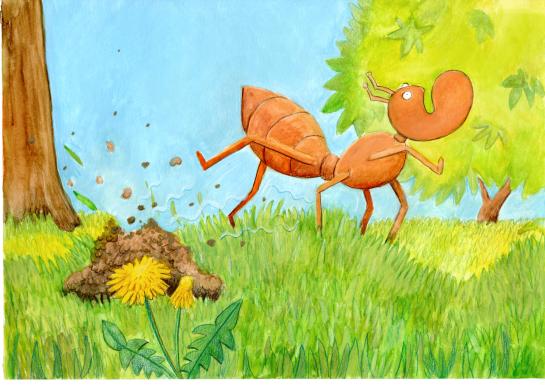
|
Possible key questions for this picture
|
|
Picture 2 - Hello worm 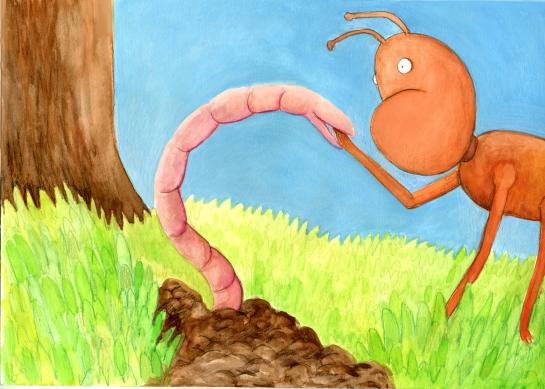
|
Possible key questions for this picture
|
|
Picture 3 - I dig tunnels 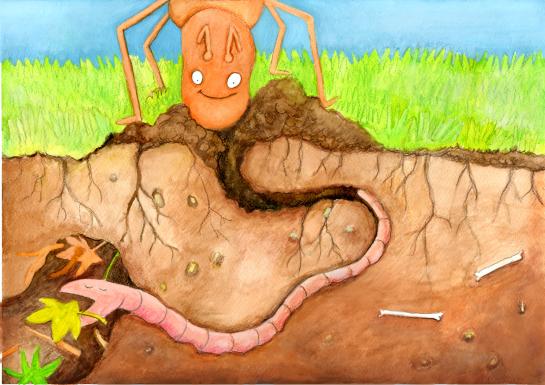
|
Possible key questions for this picture
Tips |
|
Picture 4 - Mole Cricket is ill 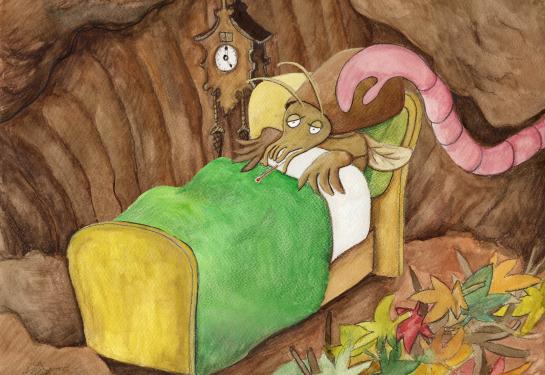
|
Possible key questions for this picture
|
|
Picture 5 - Mole Cricket eats leaves 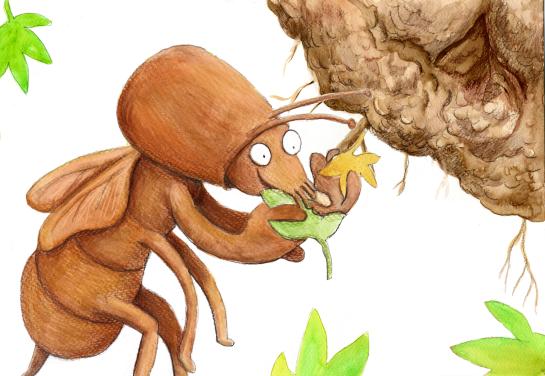
|
Possible key questions for this picture
|
|
Picture 6 It’s dark in here 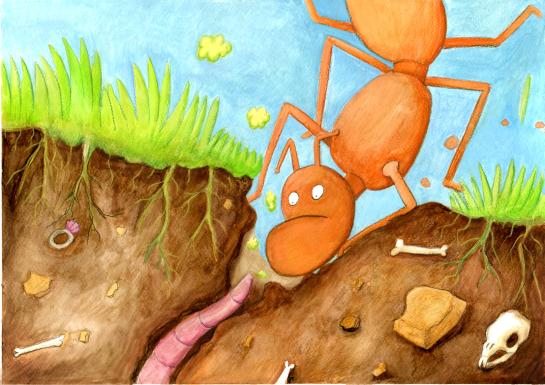
|
Possible key questions for this picture
|
|
Picture 7 - My stomach hurts 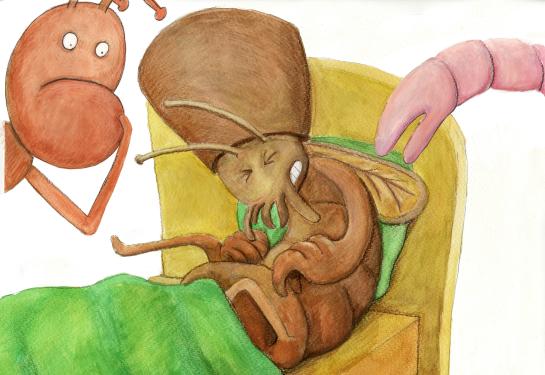
|
|
|
Picture 8 - Some people spray junk 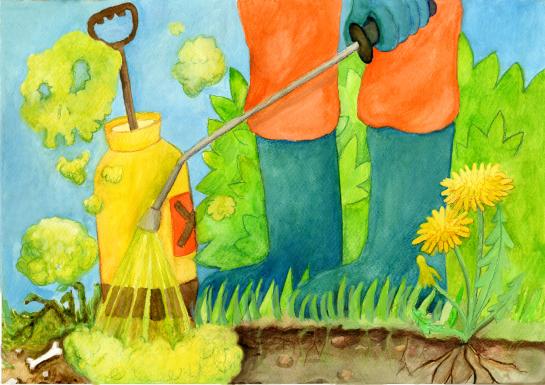
|
Possible key questions for this picture
|
|
Picture 9 - Farewell: move! 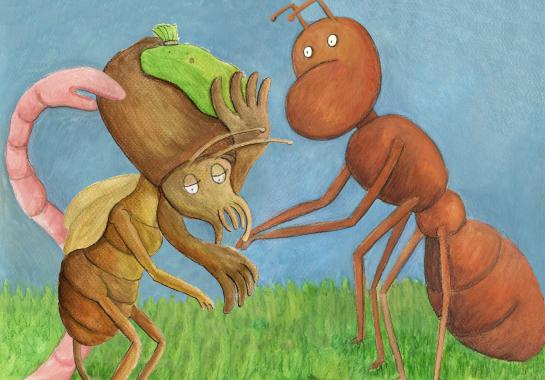
|
Possible key questions for this picture
|
Picture 10 - Reunion in autumn: moved
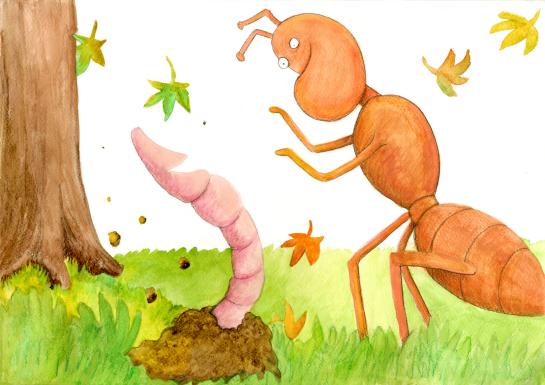
|
|
|
Picture 11 - Wormy hug 
|
The characters in the story
- Ant: picture 1, 2, 3, 6, 7, 9, 10, 11
- Worm: picture 2, 3, 4, 6, 7, 9, 10, 11
- Mole Cricket: picture 4, 5, 7, 9
- Man: picture 8
Feelings
- Picture 1: Ant is panicking
- Picture 2: Ant is surprised
- Picture 4: Ant whistles full of admiration.
- Picture 5: Worm is worried and concerned.
- Picture 6: Worm is cheering
- Picture 7: Ant looks worried, Worm and Mole Cricket are curious.
- Picture 8: Mole Cricket’s stomach aches.
- Picture 9: Ant is sad, doesn't look happy at all.
- Picture 10: Worm is gleaming and shining.
- Picture 11: Ant is happy, Worm is glowing.
- General: children's feelings for 'small animals'.
Observing in detail
- Picture 1: which yellow flower is in the foreground? What is the little pile of soil behind the flower? (not to be confused with a molehill).
- Picture 2: Worm crawls out of the pile of soil. Worm and Ant greet each other. How do they do that?
- Picture 3: what do you see under the pile of soil underground? What is Worm eating? Can you see the roots of the grasses?
- Picture 4: what is on the ground? Why is Mole Cricket in a bed? What does Mole Cricket have in his mouth? Why?
- Picture 5: what is Mole Cricket eating?
- Picture 6: Can Ant get into Worm's tunnel? Can you see the roots of the grasses?
- Picture 7: Why Is Mole Cricket holding his belly?
- Picture 8: what do you see? What colour are Man's boots? Why is Man wearing gloves? What has Man brought? What's on the pressure sprayer? Do you see the 'skull' in the shape of the clouds? Which yellow flower is coming back here?
- Picture 9: What is Mole Cricket holding upside down with its paw?
Urging/ earthquake/ saying goodbye/ all sorts of junk/ sad / trembling/ admiration/ worried/ a pile of soil/ taking a look/ a weird smell/ a weird taste/ digging tunnels/ scream/ gleam/ glow/ recognize/ in unison/ worried/ panic/ look his-her best / weird creatures / earthworm / glowing / emerge / from / move / front legs / stock / wormy hug / feel like.
Empathize with experiences and feelings through round table discussions
Retelling the story
- Hang up the pictures and have the children take turns telling the story again.
- Have the children act out the characters Ant, Worm, Mole Cricket, People.
Empathize with an Earthworm
- Put leaves, soil, grass in a play tunnel.
- Let children who want to crawl through the tunnel with a blindfold.
- Variant: scent game in which the children have to follow a trail along a rope, blindfolded.
- Cut a few pieces of thick wool with a length of 15 cm or more. Hand out these pieces and let the children play with the 'worm'. Change the melody from 'pim-pam-peus' to 'Look at this earthworm, put it on your hand...' Let the 'worm' spin on their hands, around their fingers, on the ground, on their knees,…
Empathize with experiences and feelings through round table discussions
- About dealing with (fear of) small animals.
- Caring for a friend who is sick.
- Being angry / sad when animals, flowers,… are poisoned and killed.
- Who lives underground? Could you live underground?
For those who want more
- Discover the other kaMOShibai story "Ant Has a Problem" and the characters Snail, Cricket and Bee. The beginning of the story "Ant meets worm" refers to what the animals had already experienced when Ant was having a problem.
Getting to know earthworms and compost worms
Class discussion about 'junk' and 'weeds'
Constructing a theme table
- Use pictures and picture books about ants and worms.
- Add material to go on a search.
- If necessary, supplement with a worm bin.
Exploring the soil
- Visit together a wet spot in a (school) garden and a lawn.
- If possible, put a spade into the soil.
- Look for ticklish animals, benthic animals, ants and worms. Look under a layer of litter or a rock.
- Observe the animals: how are they moving? Do they have a head, a body, legs, wings, sprites? Photograph or make a video.
- Use magnifying glasses, magnifying glass jars, a sand sifter, an auger,…
- Use search maps, pictures and photo material.
- What is 'weed'? The story deals with a lawn where the dandelion is regarded as a weed and so not wanted. The dandelion is a food source for the honeybee and other insects during flowering.
Getting to know earthworms and compost worms
- Earthworms have the same grey colour on top and bottom. They are about 25 cm long, are masculine and feminine at the same time, and lie still on your hand. They are called 'earthworm', because they live in the earth. Earthworms can dig long underground tunnels. This can be done by eating soil and organic material. The tunnels they dig help the plants root well, help in the distribution of water and make the soil airier. Earthworms fertilize the soil.
- To see how earthworms make tunnels, you can set up a worm bin in an aquarium or terrarium. Alternate layers of black soil with a fine layer of sand. Put in some fallen leaves and the earthworms. After a few days you can admire the result together with the children.
- Who knows Jerome the compost worm? Compost worms are about seven cm long, reddish brown and striped. They like fresh material in decomposition, stay on the surface and rarely go deeper than 30 cm in the ground. They eat organic waste, especially leftovers from fruits and vegetables.
- To make a compost bin and to learn how to use compost: see the MOS action sheet 'Composting at school'.
Class discussion about 'junk' and 'weeds'
- The word 'junk' occurs a few times in the story. It means mess, dirty lot. It refers to the use of pesticides. These are highly toxic substances that people sometimes spray to control insects or 'weeds' in a lawn or vegetable garden.
- Check whether the children know what 'useful small animals' are. Ask them if it's okay for people to spray poison in their yard to kill small ticklish animals.
- Do the children know what "weeds" are? Do they always have to be destroyed? Aren’t there any plants that are useful and can be left standing? Are there any nasty plants? How can you get rid of them? Do the children know what weeding is?
Getting to know Ants
- Look for ants and see how they move, what they look like, how they transport things, how they work together, where they live,…
- Ants can disperse seeds, make the soil fertile and help control insects that eat leaves or seeds of crops.
- Compare with the pictures of the story in which Ant appears. See especially picture 1, 6 and 9.
Getting to know Mole Cricket
- A Mole Cricket is not a Mole, but a Cricket. They are not that common. Understanding and observing them is therefore not so obvious for young children. Look for information on the internet if you still want to go into further detail about the life of the Mole Cricket.
- Start from pictures 4, 5 and 7 to describe what Mole Cricket looks like.
- Show photo material or a movie of the Mole Cricket and compare with the pictures.
For those who want more
- The brochure soil heroes can be downloaded free of charge at https://omgeving.vlaanderen.be/sites/default/files/atoms/files/infoboekje-bodemhelden2018-LR_0.pdf
- Multilingual : https://www.iuss.org/international-decade-of-soils/the-iuss-goes-to-the-school/
Make or revitalize a school vegetable garden
Appreciating 'weeds' and sprawl
Taking animal-friendly actions
Participation by the children and by others
Organize a show moment
- Let the children tell the story with the pictures or act it out. This can be done for another class or for the (grand)parents.
- The children clarify the display table and the worm bin.
- They explain that spraying poison is not good for nature, the insects and plants.
- Take the opportunity to announce an new action.
Make or revitalize a school vegetable garden
- Find allies to create and/or maintain a garden. Don’t see it in a large.
- Inform yourself and attend information and demonstration sessions.
- Work with other classes, club volunteers and parents.
- Use compost as fertilizer.
- Plan a festive opening and other fun moments throughout the year with healthy snacks from the garden.
Avoid 'junk'
- Inform parents and grandparents about the dangers of spraying poison. Invite them to come to the school garden with their child, to work, enjoy and taste. Care for the soil together.
- Go weeding with the children on the playground, in the school garden or in the school environment. Let them put on gloves for pricking plants.
- Try out alternatives in the school garden: alternate plants, put a net over certain vegetables to prevent caterpillars. Use nasturtiums to attract aphids and chase them away from other plants. Plant marigolds (= tagetes, these flowers spread a strong scent) near certain vegetables, make nettle vulture to repel harmful insects, plant strongly scented herbs near the vegetables to distract harmful insects, indulge hedgehogs and birds in the garden (shelters and food) to fight snails and caterpillars.
Appreciating 'weeds' and sprawl
- Inform yourself about 'weeds' and take a wild-picking walk.
- Get started with weeds: make jam from dandelions, ointment from calendula, oil with herbs,…
Taking animal-friendly actions
- Build an insect hotel together.
- Sow flowers or plant bulbs to attract insects.
- Learn to make and maintain a compost bin. Or improve an initiative for this that has already been taken.
- Explain what 'mulching' is, how to do it and what its benefits are. Look for opportunities with the children to cover the ground. Collect fallen leaves, including grass clippings, to put between plants to help benthic animals.
Participation by the children and by others
- Let the children decide what actions will be taken.
- Let the children choose which plants, vegetables, herbs will be planted in the vegetable garden.
- Visit an organic garden or initiative related to permaculture.
- Work together with other classes, parents and grandparents, associations and individuals who can show examples or offer opportunities to help the children.
