
Alida is new in class. She has just come to live in our country. She has come by plane from Kenya with her parents. In their region, it has become very dry and there is a fight about water. Alida stares wide-eyed at Bilal who is drinking greedily from the drinking fountain. The children in the class do not understand this. Teacher Lut is talking about Alida's region and explains that being able to drink water is not obvious for everyone. Bilal says that some children in Morocco have to work hard to get drinking water. Sofie, Dylan and Bilal don't think it's fair that not everyone in the world can drink delicious water. They provide a gift for Alida.
Thema: water (at school)
Sub-themes: water in Africa/worldwide, drought, the right to sufficient drinking water for everyone, dealing with water in a caring way.
- You want to draw attention to World Water Day (March 22) and participate in it.
- We welcome a new classmate.
- A new drinking bottle, drinking cup, …
- Friendship booklets are being exchanged in class.
- A very hot day with drought in our region ...
- Installation of a drinking water fountain on the playground
Science and technology
Nature:
- General skills: 1.1 The pre-schoolers can distinguish differences in sound, smell, colour, taste and feeling
- Living and non-living nature: 1.4 The pre-schoolers can arrange organisms and common materials based on simple criteria they have found themselves.
- Health: 1.10 The pre-schoolers can in concrete situations recognize behaviours that are beneficial or harmful to their health
- Health: 1.11 The pre-schoolers show good habits in their daily hygiene.
- Environment: 1.13 The pre-schoolers show an attitude of care and respect for nature.
Maths initiation
- Measuring: 2.2 The pre-schoolers can compare things qualitatively and bring them together based on one or two common characteristics.
Man and society
- Man: Me and the other: 1.5 the pre-schoolers can recognize in others feelings such as being afraid, happy, angry and sad and can empathize with these feelings.
- Man: Me and the other: 1.6 The pre-schoolers know that people can experience the same situation in various ways and react to it differently.
- Man; Me and the other: 1.7 pre-schoolers can show sensitivity to the needs of others.
- Society: Socio-Economic phenomena: 2.1 the pre-schoolers can describe in a simple way adults’ occupations and activities they know.
- Society: Socio-cultural phenomena: 2.4 the pre-schoolers recognize forms of dismissive or appreciative responses to people who are different.
- Society: Socio-cultural phenomena: 2.5 the pre-schoolers will realise that some people have a different way of life compared to themselves, when they are confronted with images, information or people from another culture.
LANGUAGES
- Languages listening: 1.2 The pre-schoolers can understand questions intended for them in concrete situations.
- Languages listening: 1.3 The pre-schoolers can understand a message they’ve listened to, which was intended for them and supported by images and / or sound.
- Languages listening: 1.5 The pre-schoolers can understand a story they’ve listened to, intended for their age group.
- Languages listening: 1.6 The pre-schoolers can demonstrate willingness to listen to each other and to empathize with a message.
- Languages speaking: 2.1 the pre-schoolers can (re)formulate a message and/or story which is intended for them, in such a way that the content is recognisable.
- Languages speaking in: 2.2 the pre-schoolers can talk about experiences or events from their own environment or about what they have heard from others.
- Languages speaking: 2.10 The pre-schoolers can empathize with clearly recognizable roles and situations and respond to them from their own imagination / experience

|
Feel: empathize |
|

|
Think: explore |
|

|
|
|

|
'4.7 By 2030, ensure that all learners acquire knowledge and skills necessary to promote sustainable development…'. |
|
'6.2 By 2030, achieve access to adequate and equitable sanitation and hygiene for all…' '6.4 By 2030, substantially increase water use efficiency across all sectors and ensure sustainable withdrawals and supply of freshwater to address water scarcity and substantially reduce the number of people suffering from water scarcity.' |
|
'Ensure sustainable consumption and production patterns.' '12.8 By 2030, ensure that people everywhere have the relevant information and awareness for sustainable development and lifestyles in harmony with nature.' |
|
Picture 0 – title + cover 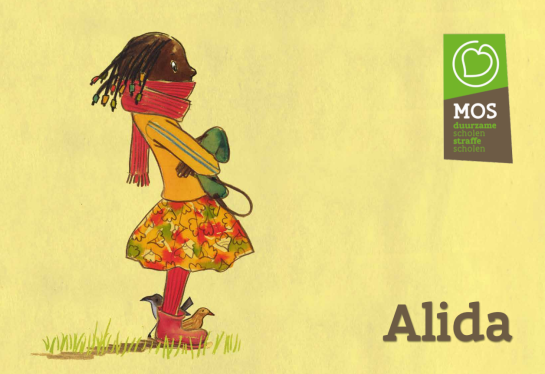
|
|
|
Picture 1- Happy to go back to school after the spring break 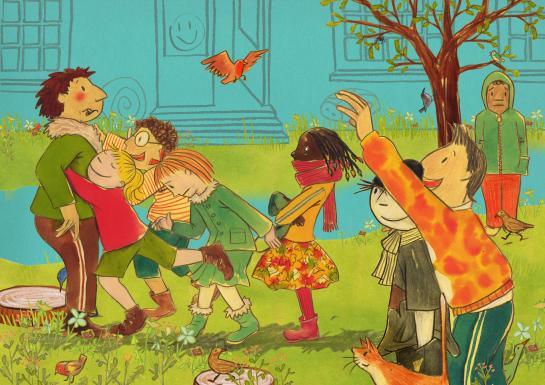
|
Possible key questions for this picture
|
|
Picture 2 - Alida comes from Kenya 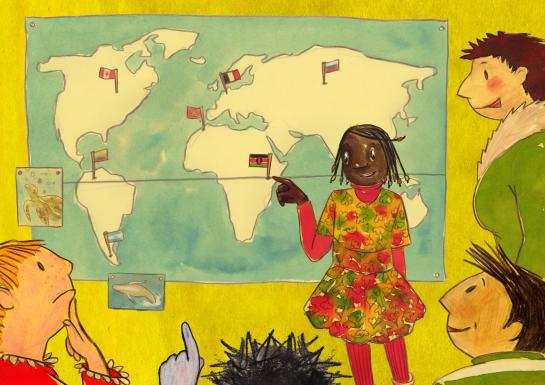
|
Possible key questions for this picture
|
|
Picture 3 - Alida gets shy 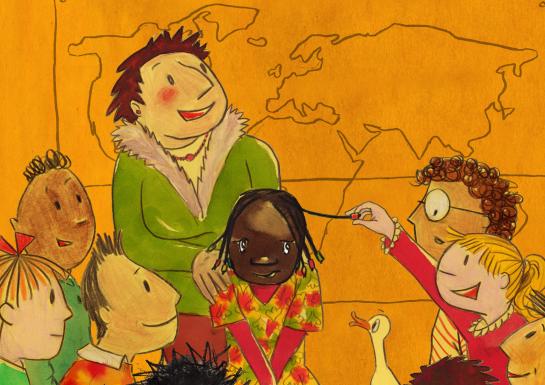
|
Possible key questions for this picture
|
|
Picture 4 - Bilal is drinking from the water fountain 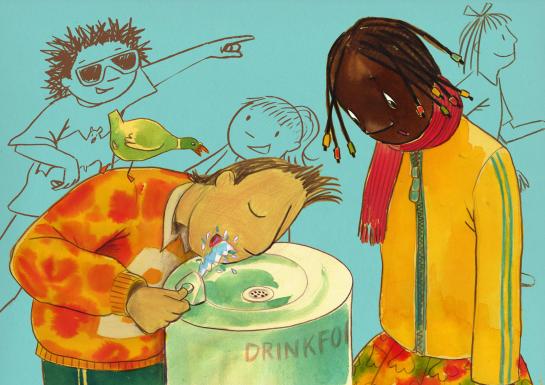
|
Possible key questions for this picture
|
|
Picture 5 - Alida has fled. 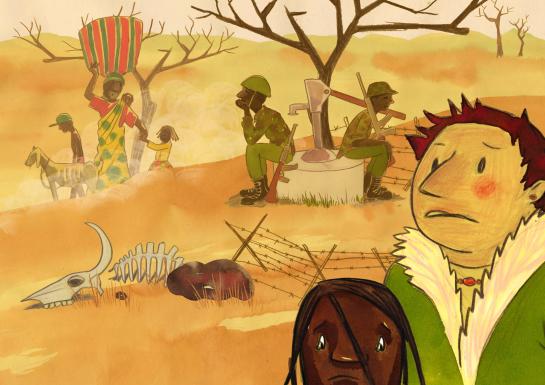
|
Possible key questions for this picture
|
|
Picture 6 - Why isn't there water everywhere? 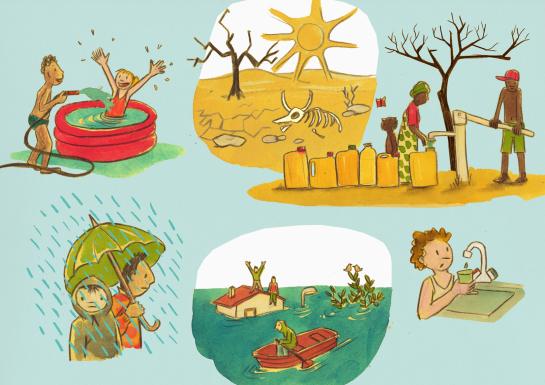
|
Possible key questions for this picture
TIP: visit a water tower, (small-scale) water purification, drinking water production centre, an (organic) farmer (where does he get the water for his vegetables, animals, ...?), ...
|
|
Picture 7 - Bilal is telling about water in Morocco 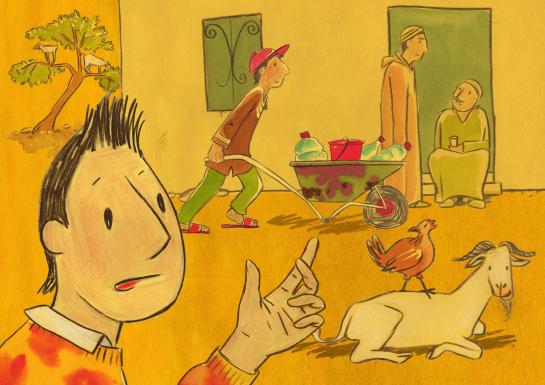
|
Possible key questions for this picture
|
|
Picture 8 - Sophie has a proposal 
|
Possible key questions for this picture
Possible activity about “hidden” water
|
|
Picture 9 - A drinking cup for Alida 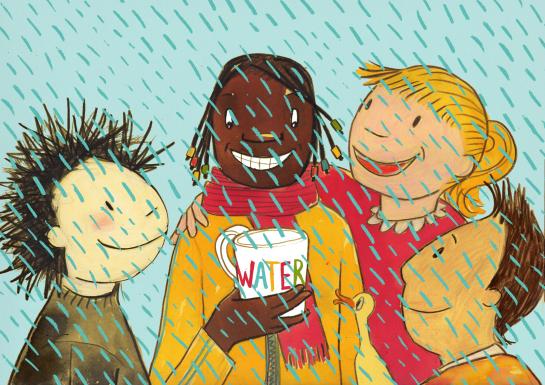
|
|
The characters in the story
- Alida: picture 1 to 5, picture 8 and 9.
- Miss Lut: picture 1 to 3, picture 5.
- Dylan: picture 1 to 4, picture 8 and 9.
- Bilal: picture 1 to 3, picture 7 to 9.
- Sofie: picture 1, to 3, picture 8 and 9.
- Other children in the class: picture 1 and 3.
- Parents: picture 8.
Feelings
- Picture 1: the children are happy, they like going to school.
- Picture 2: the children are amazed.
- Picture 3: the children are curious. Alida is getting shy.
- Picture 4: Alida is amazed.
- Picture 7: the children look at Bilal in amazement.
- Picture 9: Alida is curious, Dylan is chuckling, Alida is happy.
Research Tools
- Where can you find water?
- Picture 4: drinking fountain > drinking water.
- Picture 6: playing in water, rainwater, flood, water from the water well into bottle/jerry can.
- Picture 7: transporting water with the wheelbarrow.
- Picture 8: playing in the puddles.
- Picture 9: drinking water in the mug and rainwater from the sky/clouds.
- Where are you not able to find water?
- Picture 5: no water at all or a little water / well is guarded.
- Picture 6: last drop of water from the tap at the sink.
- Picture 2: can you look up what countries these flags are from? What animals can you find in this picture?
Observe in detail
- Picture 1: why is Alida wearing a thick scarf? Which animals do you discover in the picture? What do you notice in connection with the playground? Can you find Alida, Sofie, Bilal and Dylan?
- Picture 5: do you see Alida with her mom in Kenya? Why can you see the skeleton of an animal in the picture? Shot or killed by the heat?
- Picture 8: do you see the insect hotel? Do you know the MOS logo?
- Picture 9: what is on the drinking mug?
Comparative observation
- Picture 2: find the flags of Belgium, Kenya and Morocco. Indicate that the flags are put where Belgium, Kenya and Morocco are. Draw attention to the shapes of the continents and find the continents on the globe. Make clear that the line through the picture corresponds to the equator. That is the warmest place on the globe (see 'Exploring the globe and the world map').
- Can you find and count the animals on each picture? Do you know all their names?
- Which animal is found in Kenya (picture 5) and in Morocco (picture 7)? Who knows that animal? Does it also live in Belgium? What does that animal give?
Introduce to someone / attention / all colours of the rainbow / confirm / circle / thirst / urge / drinking water / drinking water fountain / a large (world) map / most normal thing in the world / chuckling / greedy / running / colourful / spring break / wheelbarrow / twisting the hands / not fair / our country / pearls / suddenly / noise / quarrel / sip / stare, tail / region / emerge / from / feel safe / shy / braid / flee / filled with wonder / proposal / water pipe / dig wells / winter sun / she bares her teeth / they say in unison.
Retelling and acting out the story
Exchanging experiences and feelings about the following topics via circle discussions
What do we need water for? What would happen if we didn't have (drinking) water?
Introductory game “Walk for Water”
Retelling and acting out the story
- The children can empathize with the characters and they can act out the story.
- Further develop the dialogues among the characters: let Sophie show a few more things and have her ask questions to Alida and vice versa: can you teach us to count in English? What do you like playing? What is your mom and dad's name? Do you love animals? What is your favourite animal? And what is your favourite colour? etc.
- Provide clothes and objects to act out the story.
Exchanging experiences and feelings about the following topics via circle discussions:
- The use of water throughout the day.
- Having access to water is natural for many people here. We easily have a lot or little, hot, lukewarm or cold water. Is that the case with everyone?
- Have you already experienced not to be able to use water for a while or having been thirsty during a long walk or a car ride. Or have you endured a leak in a water pipe in the street, resulting in no water in your house. And what about having to shut off the water during renovations in the house? Or it is very hot and dry and there is little water, .. it is very dry and you can not use water,…
- There’s a new child in the class during the school year.
- Getting a drinking cup or drinking bottle as a present.
- Feeling (no longer) safe, fleeing because of extreme drought and lack of clean water, fleeing because you can't live there any longer, arguing about water/war?
What do we need water for? What would happen if we didn't have (drinking) water?
- Have the children list what they use water for throughout the day. Use pictures to inspire them. Use some of the objects from the theme table.
- Challenge them to think about what they would do if only little or no water was available. Let them discuss about reactions, proposals and solutions.
Introductory game “Walk for Water”
- The children can empathize with the situation of children who have to fetch water every day and cannot go to school. See explanation with picture 6: 'In some countries the sun shines brightly and it rains little. Sometimes there is not enough money to dig wells or lay water pipes; some children are on the way all day to fetch water."
- Organize a circuit outside the children can run in groups. Explain that you are going to act as if there is no water tap in the school or in the neighbourhood. Have the children formulate proposals. Show pictures of children who are fetching water. Give each child a cup and start searching together. First, walk to a place where you can find polluted water (pond, puddle or bucket) that you have placed somewhere beforehand). Congratulate the children for finding water so quickly. Ask them if they can drink this water and what will happen if they drink contaminated water. Invite them to continue their way to the 'water well' (second bucket you’ve placed beforehand). On the way, tell about the heat, the long distance, being tired and thirsty. Let the children discover for themselves that there is no water in the well. The well has dried up. Ask them how that is possible and what they must do now. Tell the children about a well or a water tap in the next village. Invite them to step move on and sing a song. Let the children fill their cups with a little water from the well (a third bucket or a water tap). They can quietly drink their cup and enjoy the water.
- During the debriefing, provide opportunities to exchange feelings and insights and to draw conclusions.
For those who want more
- Confirm and encourage the exchange of friendship books. Optionally, use a friendship book for the class. Give space to questions, differences, arguing, coping with being different,… Everyone is included!
- The 'Cricket Book' can be downloaded from the site of “children's rights schools”. The book contains an extensive chapter on 'water' for pre-primary education and also a water chapter for primary education.
- The Zuiddienst of the City of Roeselare published the picture book DEAU and 3 manuals in 3 boxes of the “Do the Deau” package. The package is about the preciousness of water and how toddlers can use it sustainably. In the manual of box 3 you can find a detailed game based on 'Walk for Water'.
Water during the day, home and at school
Research tour 'Water is everywhere at school'
Clarifying features and concepts related to water
Observe drought / water shortage in our region
Explore the globe and world map
Become acquainted with children, water and drought in Kenya or Morocco
Expressive modelling and writing
Promoting children’s participation and their surroundings
Compose a theme table
- The theme 'water' comes about in many variants in the children’s world: eating and drinking, taking a bath or shower, playing with boots in the rain(puddles), swimming, a day at the sea, having fun in the snow, washing body and clothes, teeth brushing, washing dishes, taking care of plants and animals, toilet use, ...
- The children can each bring an object associated with water into their everyday world. Make sure the children can say something about it or do something with the object. Have children explain and show to each other how and for what purpose the objects are used.
- Provide additional objects and picture books. Let the children decide for themselves that there are many objects that have to do with water and that water is important for human beings, animals and plants.
Water during the day, home and at school
- Go with the children over a day from morning till evening. Use images and objects to support. Write down or draw the times of day when water is used.
- Complete the overview with the moments of water use at school.
- Choose a method to measure the water use of the class during e.g. a day. You can use tokens for this. You agree on how many tokens you use for toileting, washing hands, drinking, etc. Every time the children use water, they can place one or more tokens in a box or jar. Count the tokens at the end of the day. Place the tokens in a long line with the children. Compare this with another day.
- Let the children feel and put into words where and how they can do with less water.
Research tour 'Water is everywhere at school'
- Look for places that can be connected with water in the classroom, in the school building and on the playground.
- Look for the water meter and the water pipes at school. Where does the water come into the school? Where does it come from? How is it distributed in the school building? Where does the used/dirty water go? How is it drained? Can we find the pipes?
- Take pictures and collect samples of water you’ve found: tap water, rainwater, dirty water,…
- Make an observation of a drinking water fountain in the school or nearby. Show how to use the fountain. If the fountain has not been used for several weeks, you should let the water run for two minutes. In that case, collect the water for cleaning or for watering plants. Do not use the fountain to wash your hands or to rinse out paint brushes. Discuss the pros and cons of a drinking water fountain.
- Make an observation of a toilet. Is it a toilet with or without a button to save water? Let the children explain the use of the button to save water or explain how to use water economically.
- Observe some pictograms in connection with water and sparing water use. Let the children design their own pictograms as well.
Clarifying features and concepts related to water
- Show the children the difference between potable and non-potable water. Tap water is usually drinking water. Sometimes there is a pictogram near the tap meaning you are not allowed to drink from it.
- Clarify that you should drink when you are thirsty. Water is good for thirst. Water is healthier than soft drink.
- Let children taste the difference between bottled water and tap water. Tap water is healthy! And you don't use plastic.
- We use drinking water to flush the toilet, to clean, to wash clothes, … Is that a good idea? Is there another way?
- Teach children the difference between fresh water and salt water/sea water.
- Let children discover how you can purify polluted water yourself.
- Choose some experiments children can do themselves to find out the features of water, e.g. objects can float/hover/sink in it.
Value rainwater
- Learn to enjoy a rainy day together. Listen to the sounds. Look at the variations. Sing a happy rain song. Find out with the children how you can collect rainwater. Tell them that this is heavenly water.
- Collect objects and images related to rain.
- Make an inventory of words and situations related to rain: umbrella, heavy rain, soft rain, rain clothes, rain shower, rainwater well, earthworm, rain barrel, rain gauge, rainbow, … Complement your objects and images.
- Show what you can use rainwater for. And make it a habit to water and brush plants with rainwater.
Observe drought / water shortage in our region
- In the classroom, school, school yard and school environment, look for dry locations, withered branches, dry grass, plants and animals that crave water, dry soil, a stream or ditch where the water is low. Take pictures.
- Have the children think about how this could happen. Give additional information, explain and make the connection with drought, no rain and global warming.
- When it is dry, you are not allowed to wash the car or water the lawn,… Why?
Explore the globe and world map
- Bring around a globe or world map. Let the children respond spontaneously and let them ask questions. Do an observation of the globe. Distinguish between land and water/sea.
- Use picture 2 - Alida is from Kenya. Let them discover the shape of the continent 'Africa' on the picture. Give them the opportunity to find Africa on the world map or globe.
- Place Belgium, Kenya and Morocco on the globe with a flag on a stick.
- How would Alida have come here? By plane? By boat? Overland by train? By coach? By bike? On foot?
- Explain the concepts far/near on the map or globe.
- Use a globe to indicate the equator. Place a desk lamp near the globe and tell them that the lamp represents the sun. Let them find out that the equator is close to the sun. That’s where the warmest places on the globe are situated. Explain that Kenya is on the equator. Draw attention to the line in the middle of picture 2.
- If possible, make the connection with refugees and with current events.
Become acquainted with children, water and drought in Kenya or Morocco
- Find images about water/drought connected to the lives of children in Kenya or Morocco. You can also make contact with an organization or association that operates in those countries. (Use the search engine on www.vierdepijler.be.)
- Compare the water consumption of the class during a day with the accessibility of water and the water consumption in the country or region you’ve chosen.
- Get to know the logo of the children's “right to clean water”. Explain what this means. Every child needs water to live, play, take care of themselves, go to school. Let the children observe the logo, describe it and design their own image.
Expressive modelling and writing
- Let the children write the word "water" with a water marker.
- Demonstrate how to make a watercolour: a landscape or a scene from the story.
- Offer e.g. Aquadoodle from Ravenburger. Let children draw carefully and experiment with the water marker and the shapes on the drawing mat.
Free play
- Let the children play freely with some water objects from the theme table.
- Offer them pipes, connectors, etc. to make structures.
- Provide figures and means of transport for free play on the world map.
Promoting children’s participation and their surroundings
- Make it clear to the parents that it is best for the children to choose an object to take to the theme table together. This increases the opportunity for them to tell or show something about it.
- Let the children decide to learn more about water and children in Kenya or Morocco.
- Work together with the municipality, an association or parents to offer them perceptions about children. water and drought.
- Offer the children opportunities to get in touch and learn from professions related to water, sanitation, roofing work, gardening, nature,…
For those who want more
- Water has got an important place in the renewed food triangle. See: https://www.Gezondleven.be/themas/voeding/voedingsdriehoek/dranken. Inspiration for applying the food triangle: see KaMOShi guide 'Red, the lunch box'.
- Show the water cycle by means of videos and an image.
- What is the water footprint? Where can you find 'hidden' water? (meat, clothing, beans from Kenya,…). Hidden water in a plant (beans, sunflowers,…); what is needed to grow?
- Global warming is making some vulnerable places like northern Kenya very dry and uninhabitable. People have to move, flee,…
- Too much water: flood.
- To learn more about Dylan, Bilal and Sofie: see kaMOShibai guide 'Dylan shares'.
- Extra material: 'From stimulus to project WATER, a sea of possibilities' - for teachers of curious toddlers, from 4 years - published by Djapo.
- To make the link with global warming and with local or imported food, you can possibly explain that beans from Alida’s country have to come from very far away by plane to remain tasty and fresh. It takes a long time (too long) by boat. Also a lot of water is needed to grow beans for us.
Organize and follow up a water-scarce day
Organize actions to make heat and drought bearable
Organize and follow up a water-scarce day
- The class group gets 1 bucket of water which they have to spend the day with. Together with the children, think about how best to use the water.
- Arrange a debriefing at the end of the school day. Draw a conclusion and make agreements about the use of water in the future.
Learning to care for water
- Start with the inventory of water use in the classroom and at home. Challenge the pre-schoolers to use water sustainably and let them acquire good habits.
- Teach them how best to wash their hands and use water
- Let them indicate themselves how they can use water economically when brushing their teeth.
- Show them how to wash brushes, not under a running tap, but in a container or box.
- Discuss the use of the small flush button on the toilet and how to save water with it.
- If present, teach them how to use the drinking fountain smoothly without spilling water.
- Show them how to collect rainwater and water the plants with it.
- You can work with a water certificate if the children are prepared to handle water with care in the described situations.
Using pictograms
- Let the children design step-by-step plans and use them in connection with washing hands, brushing teeth, going to the toilet, watering plants, washing paint brushes.
- Use pictograms to indicate how you can save water. Let the children design the pictograms themselves, hang them up and make suggestions for their follow-up.
Organize a show time
- Let the children tell the story by means of the pictures or let them act it out.
- Give the children the opportunity to explain the objects on the theme table and the importance of water.
- Let the children present the step-by-step plans, the pictograms and the 'right to drink water' logo.
- Together with the children, make a call for action: collect rainwater, use water economically, support a water project, etc.
- Finish with a water reception.
- Give pictograms to the parents to use at home too.
Organize actions to make heat and drought bearable
- Together with the children, find out what you can do when it's hot and dry: cover up the windows, stay in the shade yourself, drink enough, put a water bowl in a shady spot for the birds, cover the soil in the vegetable garden with a layer of grass or shred, water the roots of plants, provide extra shade, etc.
- When it rains, collect rainwater in pots or a rain barrel, well, etc.
Support a water project
- What can we do to help children like Alida in Kenya? Informing ourselves about children around us and in the world. Finding out how we can support them.
- Get to know water projects on the website www.vierdepijler.be. Choose e.g. "water supply" and "Kenya" as search terms.
Participation by the children
- Let the children decide together which action they prefer.
- Help the children organize the show time themselves.
