

The sunlight in the room, wakes Leon up. Also in Mom and Mommy’s room, it seems as if all the lights are on. They overslept. The electric alarm clocks won’t work if Giant Colossus does not supply power. His wings have stopped. Leon and Mommy investigate their house. The lamps are not lit. The radio, TV, doorbell and heating are not working either. Fortunately, they can cook eggs for breakfast on the gas fire. The doorbell rings! Electricity is back. It's grandma with a present: an alarm clock that doesn't need electricity.
Theme: electricity in our daily lives, using energy responsibly
Sub-themes: getting up / having breakfast, wasting energy, living without electricity
- The electricity has failed in the school, in the neighbourhood, at home,… .
- Winter: it gets dark and cold faster. You need electricity/energy to light and heat.
- Lights are regularly and needlessly on in the classroom, in the hallway… The classroom’s door remains open with the heating on.
- You participate in Thick Sweater Day (first half of February).
- You want to pay attention to World Energy Day (WED), organized annually on October 22.
Science and Technology
- Technology: Core components of technology: 2.1 the pre-schoolers can specify from technical systems they often use themselves, whether they are made of metal, stone, wood, glass, paper, textile or plastic.
- Technology: Core components of technology: 2.2 the pre-schoolers can from a simple technical system in their environment demonstrate that different parts of it are related to each other in function of a predetermined goal.
- Technology: Technology as a human activity: 2.9 The pre-schoolers show an experimental and exploratory approach to learn more about engineering
- Technology: Technology and society: 2.10 the pre-schoolers can indicate that a technical system they use can be useful, dangerous and / or harmful.
Man and society
- Man: me and myself: 1.2 The pre-schoolers can describe in a dialogue with an adult, in simple language, a recently happened situation they were involved in and tell the others how they felt about it.
- Man: me and the others: in group: 1.10 the pre-schoolers can make arrangements in concrete situations with the help of an adult.
- Society: Socio-cultural phenomena: 2.3 the pre-schoolers can recognize different family types.
- Time: 3.1 the pre-schoolers can use the concepts today, day, night in their correct meaning.
- Time: 3.2 the pre-schoolers can indicate a limited number of fixed events in the course of the day in the correct order
Languages
- Language Listening: 1.2 the pre-schoolers can understand questions intended for them in concrete situations.
- Language Listening: 1.3 the pre-schoolers can understand an oral message intended for them, supported by image and/or sound.
- Language Listening: 1.5 the pre-schoolers can understand a story they have listened to, intended for their age group.
- Language listening: 1.6 The pre-schoolers can demonstrate willingness to listen to each other and to empathize with a message.
- Language speaking: 2.1 the pre-schoolers can formulate or reformulate a message intended for them and/or a story intended for them in such a way that its content is recognizable
- Language speaking: 2.2 The pre-schoolers can talk about experiences or events from their own environment or what they have heard from others
- Language speaking: 2.10 The pre-schoolers can empathize with clearly recognizable roles and situations and respond to them from their own imagination / experience
|
|

Feel: empathize |
|
|
|

Think: observe and explore |
|
|
|

Do: work in an organized and active way with the children |
|

|
'4.7 By 2030, ensure that all learners acquire the knowledge and skills needed to promote sustainable development' |
|
'7. Ensure access to affordable, reliable, sustainable and modern energy for all' |
|
'Ensure sustainable consumption and production patterns.' |
|
Picture 0 – title + cover 
|
|
|
Picture 1 – Leon wakes up startled 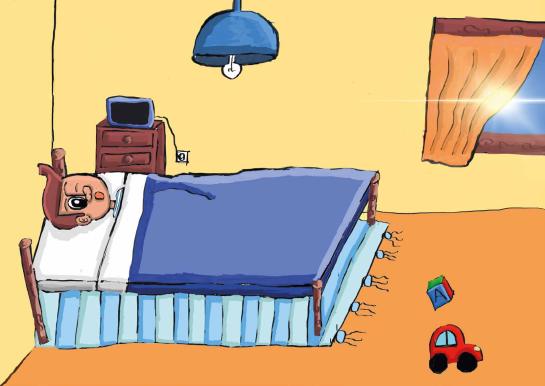
|
Possible key questions for this picture
|
|
Picture 2 - The light does not go off or on 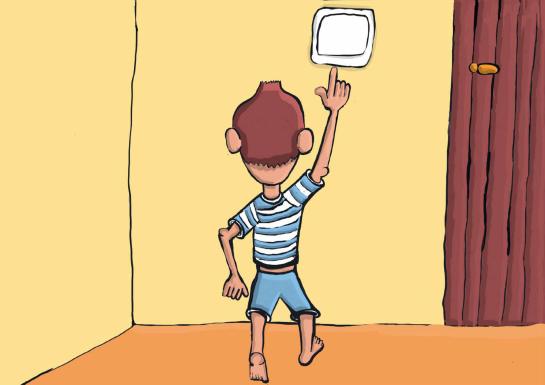
|
Possible key questions for this picture
Possible activities for this picture
|
|
Picture 3 – to mom and mommy 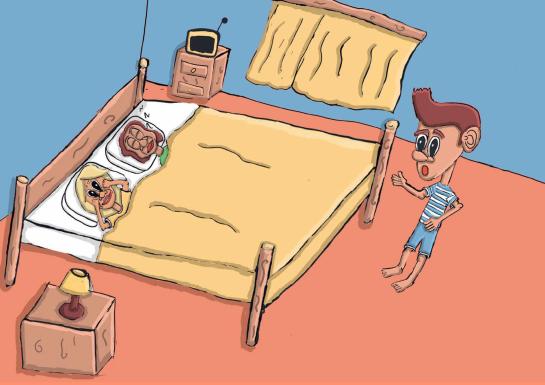
|
Possible key questions for this picture
|
|
Picture 4 - the electricity has gone out 
|
Possible key questions for this picture
Possible activities for this picture
|
|
Picture 5 - Does everything then work on electricity? 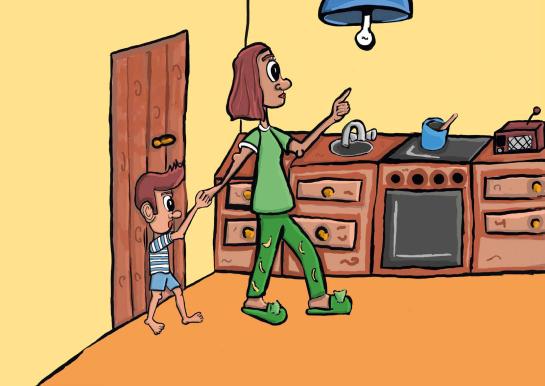
|
Possible key questions for this picture
Possible activities with this picture
|
|
Picture 6 - without heating, a thick sweater helps 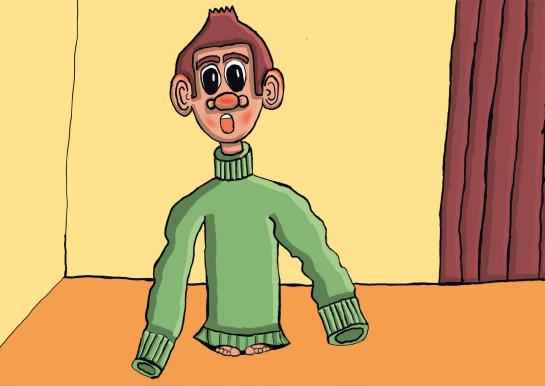
|
Possible key questions for this picture
|
|
Picture 7 – Eager to warm up 
|
Possible key questions for this picture
|
|
Picture 8 – Eggs can be cooked on gas 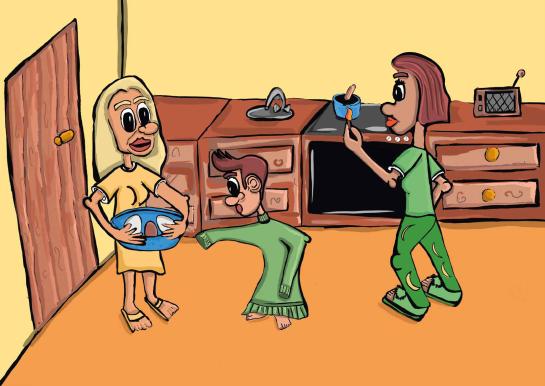
|
Possible key questions with this picture
|
|
Picture 9 – Electricity is back 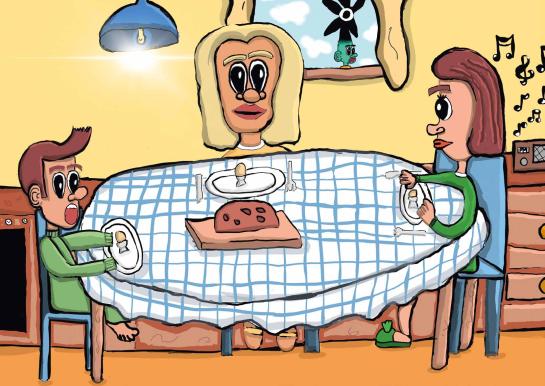
|
Possible activities with this picture
TIP:
|
|
Picture 10 - an old alarm clock from grandma 
|
Possible activities with this picture
|
The characters in the story
- Leon: all pictures
- Mom and Mommy: pictures 3, 4, 7, 8, 9, 10
- Grandma: picture 10
- Giant Colossus: picture 4
Feelings
- Picture 1: Leon wakes up startled, is afraid, confused
- Picture 2: Leon is a bit disappointed because he can’t do magic
- Picture 5: Leon likes to go exploring. Leon is cold.
- Picture 6: Leon is nice and warm. He's glowing.
- Picture 7: Leon is cold again. He is getting very hot and sweaty. Leon gets hungry and feels weak (he’s running out of energy).
- Picture 9: Leon is happy, relieved. He is enjoying breakfast and feels his energy coming back.
- Picture 10: grandma is curious. Leon takes pride in guiding. Grandma doesn’t feel confident! Everyone is happy with the alarm clock
Research tools
- Picture 1 and 2: where do we still find sockets and switches in the class and in the school.
- Picture 1 and 3: what do Leon, Mommy and Mom use electricity for in their bedroom? You too?
- Print 4: can we find out more about Giant Colossus? (see other story: 'Giant Colossus is very upset’).
- Picture 6: how do you wear a big sweater? Is a big sweater always warmer? Is a big sweater always a thick sweater?
- Picture 7 and 8: what can you do without electricity?
Observing in detail
- Picture 4: what are the chickens called? What do they take care of?
- Picture 7: what is in the basket on the dining table?
- Picture 8 and 9: what do they eat for breakfast? Do you sometimes eat that too?
Comparative observation
- Picture 4: what similarities/differences do you notice between Leon and Giant Colossus’s clothing? Who has similar pyjamas?
- Picture 5 and 9: what do they use electricity for in the kitchen? Also at your home?
In general
Curious / rub the sleep out of your eyes / a brilliant idea / don’t feel confident / flop / guide / do magic / curtains / scamper / you never know / goosebumps / immediately / nightstand / discovery trip / go exploring / stand upright / sleepyheads / sleepy / snore / search / steeply upwards / stand still / come forth / bring down from the attic / oversleep / don’t move at all / forehead / his hunger is soon satisfied / sweat
Energy / electricity
The power is out / strike a match / power cut / glow / light the gas cooker / cooking fire / match / ceiling light / magic button / waste / heating / alarm clock / wings wave / his energy is running out
Exchanging experiences and feelings by means of circle discussions
Re-enact the story
- Let the children empathize with the characters and situations of the story.
- Maybe you can really act out the story together: sleep, wake up, wake each other up, warm yourself, cook an egg for breakfast… Or experience the difference between waking up without an alarm clock, with an electric alarm clock, with a battery-operated alarm clock, with an old mechanical alarm clock you have to wind up,…
- Let the children develop the story, e.g. what do you still do when you get up and have breakfast, go to bed? Do you use electricity in the process? What happens to grandma's alarm clock?
Exchanging experiences and feelings by means of circle discussions
- Have you ever experienced a power cut? Without light, without heating,…
- Dark and light, feelings
- Wake up, snore, oversleep, haven’t heard the alarm clock, have breakfast, alarm clocks and clocks
- Feelings when you are warm due to a thick sweater, a blanket, cuddling, moving, ...
- Mommy, mom, grandma: who do you live with, what names do you use?
Exchanging experiences and feelings you’ve had with electricity / electrical appliances in your own environment
- Who knows how to turn on/off the light? Does this sometimes happen automatically?
- Do you have things at home that require energy or electricity when you want to work? In the kitchen, bathroom, bedroom, office, garage, outside, ...
- Who uses an electric toothbrush? Night light?
- Experiences with tablet, electric bicycle, bicycle trailer, car, toys,…?
What would happen if?
- Let the children empathize with situations related to the story: what would happen if you didn't wake up in time? Is that the same at weekends? What would happen if there was no electricity for a while?
- What would happen if there was not much electricity available? What would you do when it's dark?
- What would happen if there was no electricity for a whole day or more?
Constructing a theme table / technical table
Inventory what works on electricity at home and at school
Overall perception or electricity/energy in the environment
First introduction to the concept of 'energy'
First introduction to the concepts electricity and power
Go into more detail on global perception
Participation by the children, (grand)parents and others
Constructing a theme table / technical table
Provide a good variety. Complete or discard depending on the children's interests:
- All kinds of children's alarm clocks, a flashlight, a (desk) lamp, a power bank and mobile phone charger, a tablet or computer, a globe that you can light, a vacuum cleaner, ...
- All kinds of materials and devices that need or don’t need electricity to work.
- Battery operated toys and comparable toys that do not require electricity or batteries.
- Variation in buttons, cords, switches, small appliances,…
- Provide some discovery boxes to experiment, e.g. to light up lamps with a battery, e.g. in a mini Christmas tree, to use/make wind to light up a lamp, ..
- Images, e.g. from advertising brochures, photos, picture books.
- Provide a research booklet to record or draw the establishments.
Inventory what works on electricity at home and at school
- At school: school bell, computer, toys,…
- At home: lamp, TV, tablet, mobile phone, vacuum cleaner, coffee machine, radio, clock, toaster, dishwasher, dryer, CD player, hair dryer, electric toothbrush, toys, waffle iron, hot water kettle, doorbell, electric bicycle, electric car, ...
- Make an ordered list of this enumeration at picture 1 - Leon's bedroom, at picture 5 or 8 - kitchen, etc.
- Let children draw the appliances/devices. Use images from brochures,… Put together a photo booklet for the theme table or book corner.
Overall perception or electricity/energy in the environment
- Start a brainstorming session and make, with the children a mind map about electricity in their environment: in the classroom, at school, in the street, at home, …
- Start the exploration in the classroom: how many devices in the classroom need electricity? Count, draw, …
- Look together for electrical appliances, sockets, switches, lamps with switches or that turn on and off automatically, possibly power lines on the wall, an electricity meter, a fuse box, batteries, an extension cord, …
- Let them experience switching on and using electricity in concrete situations.
- Discuss the usefulness, power and danger of electricity.
- Let the children observe in detail an extension cord with and one without a switch.
- Maybe you can warm up/bake/cook something on gas, electricity?
- Visualize a power circuit and explain and show how it works: socket, cord with switch, lamp, …
- Have the children mark on a simple floor plan of the classroom some places where electricity can be found. Or let them draw where electrical appliances are located and where they get electricity.
First introduction to the concept of 'energy'
Be very attentive to children's questions. Give them a lot of opportunities to discover, better understand and reword clearly situations related to energy:
- Let the children discover that you need energy to make something work.
- You need energy to grow, to move, to walk around the table, to pedal on the spot, …
- Your body gets energy from healthy food.
- Animals also need energy/nutrition to grow. Plants and trees get energy from good soil and manure and from the rays of the sun, …
- Machines, appliances and equipment also need energy to work. This can be realized by winding them, turning them, pushing them, pedalling, … . E.g.: some lawnmowers you can push. Other run on electricity or on fuel (gasoline). Compare the pros and cons.
First introduction to the concepts electricity and power
Here too, be very attentive to the questions of the children. Do not do this only while processing the story or while developing a theme. Give them a lot of opportunities throughout the year to understand what electricity is. Also discuss the pros and cons:
- Electricity is energy that passes through a line or electrical cable. E.g., from a socket to a lamp. Another word for 'electricity' is 'current'.
- Electricity can be produced by burning fuels such as diesel, petrol, coal or gas. This (grey) current creates 'dirty clouds'. See KaMOShibai story 'Terra'.
- Electricity can also be generated by nuclear power stations. Nuclear power plants also produce dirty clouds, but above all extremely dangerous nuclear waste that is difficult to dispose of.
- Green electricity is electricity from windmills, water or solar panels. Green electricity is generated without dirty clouds and without waste. You can continue generating green energy as long as there is sun or wind. As regards windmills, see KaMOShibai story 'Giant Colossus is very upset’'.
Observing batteries
- Make sure you have a well-diversified collection of batteries. Give the children opportunities to discover some characteristics: difference in size, plus and minus sides, strength… Use e.g. toys or a second-hand 'electro game' to demonstrate how a battery works. List together with the children what items batteries are used in. Distinguish between batteries that are in position and secured well and those that you can replace. There are batteries that you can recharge and there are 'disposable batteries'. They are not rechargeable. Have you ever seen a battery charger? Discuss the pros and cons. Batteries are useful when there is no power socket. You can conserve nature's resources by using fewer batteries. Board games and toys without batteries are also pleasant to play together!
- Explain that a small amount of electricity is stored in a battery. They are not that dangerous because there is 'weak current' in a battery. Weak current is electricity with a low voltage (up to 24 Volt). Electricity in power sockets and thick cables is very dangerous,…
- You have to be careful with batteries (don't put them in your mouth, don't leave them lying around,…). They are very poisonous.
- When they are empty, there is no more electricity in them. They are then collected in a box or in a barrel and are taken to the recycling centre. They are used to make new batteries.
- An electric bicycle, an electric lawnmower, an electric car, etc…, contain large batteries. They don't emit dirty clouds.
Go into more detail on global perception
- More focused observation of power sockets, switches and buttons. Provide sufficient variation in the objects to be observed: push button, all kinds of switches, string, lights with switch… Make agreements as regards use, safety and caution (safety education.
- More intense perception of alarm clocks, a clock, a watch. Search for alarm clocks on the pictures of the story. Look together for alarm clocks, ordinary clocks, ... in the classroom/at school. Add with alarm clocks you brought with you. Provide variety in the amount of energy needed to run the alarm clocks. Compare the external differences and similarities. Explore characteristics. What is an alarm clock used for? What are the numbers for? How does an alarm clock work? With or without electricity? Battery? Wind up?
- Comparative observation of a flashlight and a (desk) lamp. Challenge some children to observe a desk lamp and explain its operation (with plug, wire, switch, LED lamp or other) to the other children in the class. Explain how a simple power circuit works. Do the same with a battery powered flashlight. Notice the difference between regular (disposable) and rechargeable batteries. Demonstrate a flashlight that has to be wound up. Let the children discover differences and similarities.
Participation by the children, (grand)parents and others
- When processing this story, it is extra important to reflect on and go into more detail on the children's questions. Their involvement determines what aspects you can elaborate on.
- Work together with parents and grandparents to collect and demonstrate a number of examples that require energy but not electricity. Some examples: an alarm clock or clock to wind, fruit press, make mayonnaise, do your own laundry, grind coffee with an old coffee grinder, make light with candles, push a lawnmower,… Use the examples to show that most things can now be done electrically. People invented all kinds of devices to make jobs easier and without having to use your own energy. Challenge the kids to invent appliances and make their own.
- Invite (grand)parents with a profession or hobby related to electricity (electrician, light and equipment shop, electric model trains, Christmas lighting, mood lighting, theatre company decor and lighting, etc.) to work together. Visit a store or organization near you.
Help each other to use electricity more economically
Organizing a show moment for parents, grandparents, other classes,…
Participation of the children and their environment
Help each other to use electricity more economically
- Organize a circle discussion about how children are caring for electricity at home and in the classroom: let them give tips they have already heard or tips they have invented themselves: don't turn on too much light, turn off lights when you are not in the room, close the doors well, let the sun in and open or close the curtains as needed, put on a thick sweater and lower the heating, do not use too much hot water, e.g. for a shower, use new LED lamps instead of old ones, avoid standby consumption, …
- Examples where energy is required but electricity is not (see participation under 'thinking, observing and researching'), may also provide inspiration for actions, e.g. use a wind-up alarm to announce the clean-up.
- Together with the children, choose the most important tips they want to apply in the classroom for an agreed period. If you observed beforehand how they deal with electricity in the classroom, you can confront them with it. Make agreements. Have the children sign the agreements. Hang them in the places where the agreements are applied. Encourage the children to help each other. Use the children's drawings to create icons for the agreements.
- Discuss the results regularly. Let the energy captains keep track of the follow-up of the agreements in a table: well followed / could be improved. You can always think of another name for the 'energy captains'.
Organizing a show moment for parents, grandparents, other classes,…
- Have a few children act out Leon's story.
- Help the children to tell something about some things from the theme table. Make sure they can demonstrate, for example, a power circuit.
- Display the children's inventions and artwork. Have them explain it.
- Support the children to clarify some agreements and drawings regarding energy waste. Have them explain how to follow this up in class. Make an appeal to also reduce energy waste with agreements at home or in other classes. Give a copy of the icons you use in class to anyone who wants it.
- Provide parents with a theme bundle so they can see how you handled it in class.
Organizing a low-energy / 'low-electricity' day with the class or the school as a step towards a sustainable energy policy
- Find out what you use electricity in class for and what you can do without electricity.
- Inform other classes and parents that you will use as little electricity as possible during a full or half day. Have the children explain why you are doing this.
- Ask the parents to give their child a thick sweater, …and a cap or hat to take to school.
- Turn the heating down a bit. Use an old school bell. Sing together instead of listening to music. Do not use lights and do not use a computer either. Put the toys which need batteries on the cabinet after children have understood they do not work without batteries. Provide cosiness, a rich range of games and exercise indoors and outdoors, stories and lots of variety. You don't need electricity for a kamishibai story either. Are you also prepared not to use your mobile phone or tablet for a day?
- Discuss with the children what they think about it and what they’ve learnt from it. Compose a box with objects and tips to 'survive' with the class, if one day the electricity really goes out.
- Discuss with the children how often you want to repeat this so that it is not just a one-off initiative.
Participation of the children and their environment
- Let the children decide for themselves as much as possible which action they prefer and what exactly they want to do at the show moment.
- Give children the space and support to propose and maintain actions themselves, e.g. collecting batteries.
- Work together with colleagues and management to make the school environment completely child-safe and sustainable. Provide power sockets and extension cords that do not pose any danger to children. Replace defective bulbs with LED lighting. Ask for sensor lighting in the hallways and on the playground. Encourage the installation of solar panels. Measure and reduce energy consumption. Use a feed-through plug or energy meter in order to measure how much an appliance is consuming, an extension cord with switch, a thermometer, draft strips, a shower timer, etc.
- Participate in actions by the municipality and associations to deal more consciously with energy and electricity in the school environment.
