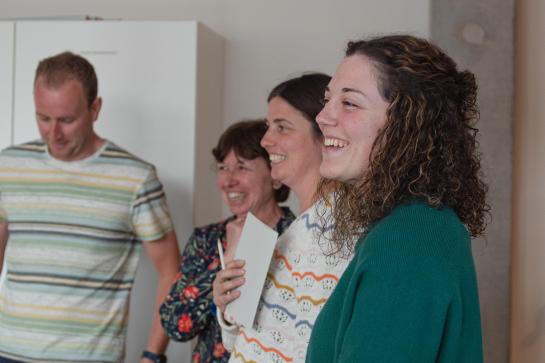

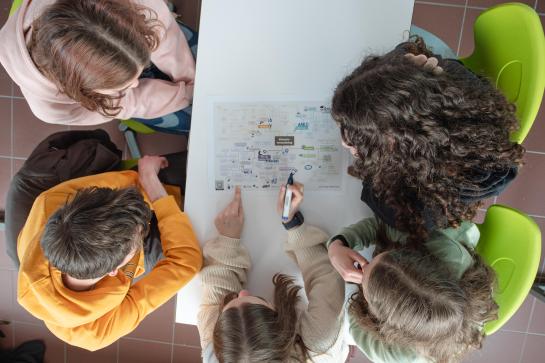
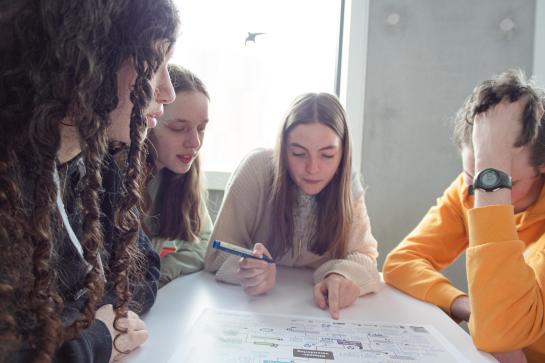
This Fun Example shows high school students and teachers showing a genuine concern for the world around them. We see how they are committed to a sustainable world. World citizenship education and sustainability education go hand in hand here. Hopeful and enterprising students discover together with their teachers how they can make a difference.
An ordinary school day, in an ordinary MOS school. Groups of students search for litter, others hold a lunch box campaign during lunch break, bird stickers warn birds about the window glass. Nothing out of the ordinary going on, you might say. Until ... you notice that there's also a chicken sale going on, a tantalizing exhibit about other cultures is running, and you hear students enthusiastically discussing immersion stays. 'We notice that this trip is enormously enriching for many students,' says Barbara Van Baelen, the school's initiator. 'In the course of the project, you see the involvement in global or climate-related themes grow spectacularly.'
Applying to join
It all started back in 2006-2007, when Barbara managed to set up a first exchange through her connections in Bolivia. Thus, a two-year immersion program, alternating between Bolivia and Tanzania, was born. 'We do this every two years because the organization requires a lot of effort, both for the teacher and the student,' Barbara explains. 'Think about the application process, the immersion weekend, the fundraising, the trip itself, the lessons to be made up and the feedback to the rest of the school, for example with an exhibition.'
Students who want to come along write a cover letter to apply. In addition, they must raise the necessary money to pay for the trip. 'We expect a lot of energy from the students, and quite a bit of money, so we want to make sure that those who go along are also motivated,' says Barbara. Liene Permentier, a 5th year and member of the MOS Council, wants to go with us to Bolivia next school year. 'I want to work for it myself,' she says determinedly, 'but my parents have already said that they will also contribute.'
But before Liene can leave, there is a lot of preparation to be done. It starts with a familiarization weekend to provide the necessary cultural background. 'The immersion trip itself takes on much more depth this way,' says Barbara. 'Do such a trip without preparation and you get a kind of superficial safari,' she continues. 'Now students can begin their journey with an open mind, without prejudice.'
Creative fundraising
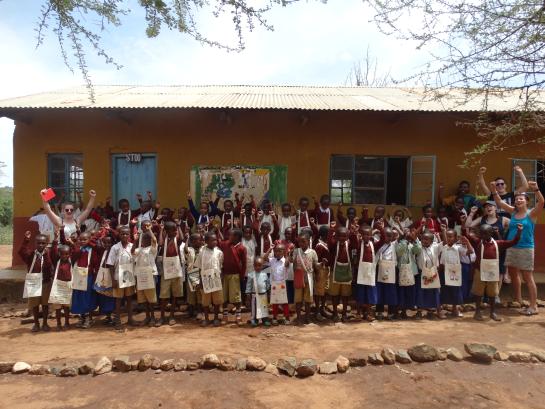
Sarah Coeckelberghs is a former student of the school. She went to Tanzania when she was in 6th grade. 'To raise money, the students made fashion fabric bags,' she says. 'These were sold, colorfully decorated and taken to Tanzania.' Not much later, a photo came back from Tanzania: the students over there were using the bags as book bags. 'We also organized a charity party and sold banana bread,' Sarah adds. 'You could also buy a school bench and donate it to the school in Tanzania.'
'This year we are selling naps for during class,' says Liene. 'As a student, you can buy off a five-minute siesta, which you can request during class.' The teacher is still allowed to refuse the request. 'It's really nice to be allowed to lay your head on the couch for once, without the teacher saying anything.'
With your own eyes
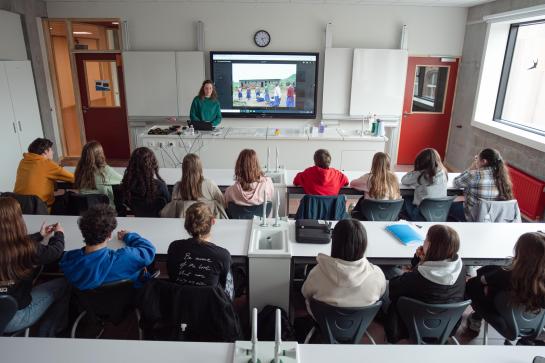
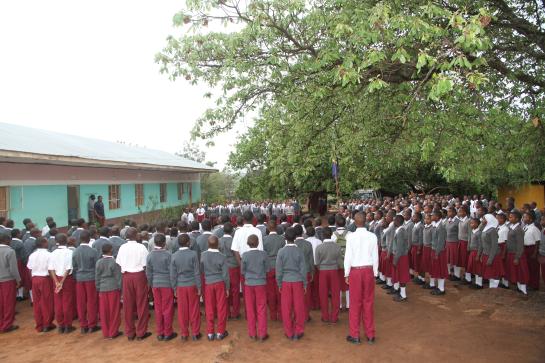
Then the day arrives. 'First comes the culture shock,' Sarah explains. 'You just don't realize we have such a luxurious life.' During their stay, the Belgian students join the local school for a week. They eat together, sleep in the same conditions and participate in Sunday church mass. 'You meet yourself several times and push a lot of boundaries. You are really immersed in another world. Around age 18, adolescents' worldview begins to expand. That's when an experience like this really comes in.'
In addition to cultural exchange, the trip is linked to a humanitarian project. When the group was in Tanzania with Sarah, this was the construction of a water pipeline that the school had co-funded: the 'Maji' Endallah Water Project, an initiative to guarantee 5,500 residents of the village of Endallah access to clean drinking water all year round. 'People were getting sick from the small amount of water out of the dried-up river,' says Barbara. 'And this didn't get any better because of a more extreme climate with longer droughts.'
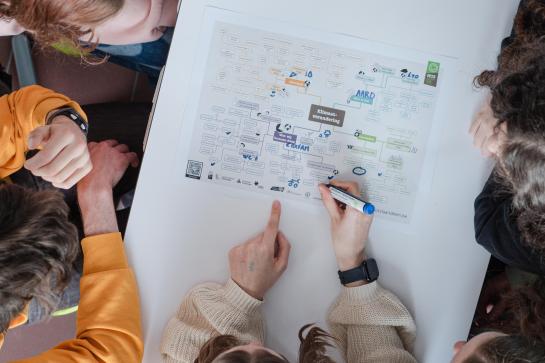
'Climate is a story from all over the world,' says Frieda De Hertogh, the school's MOS Council facilitator. "The story becomes tangible, and suddenly you are able to see with your own eyes what climate change can mean. According to Barbara, it's all connected. 'It's about increased global awareness that issues like climate change or inequality between north and south are ultimately all connected.'
'Then you return to Belgium afterwards and you hear people on the bus complaining about the weather,' she concludes. 'We can be thankful with enough water here.' Sarah is now a nurse in the tropical ward in a hospital. The seed for tropical medicine was planted here at school. "The goal is to eventually work for Doctors Without Borders, for example in Tanzania.
A report from Always Hungry
A few more comments by MOS
- The primary purpose of immersion trips is to enrich yourself and your entourage. In addition, it is important to put local ownership at the center. Strengthen local initiatives, but don't take the lead yourself. Even without your help, locals can realize the projects.
- This example zooms in on the learning process of the students in Belgium. Naturally, we consider the local partner to be equally important.
- Make sure that immersion trips are accessible to all students in the school.
Want to read more?
Read the report 'Dutjesverkoop, Hotel Endallah en Pastanzania' on the school website.
The 4e Pijlersteunpunt of 11.11.11 supports anyone involved in a project of international solidarity from Flanders and Brussels.
School details
Ursulinen Mechelen
Hoogstraat 35
2800 Mechelen
-
-
-
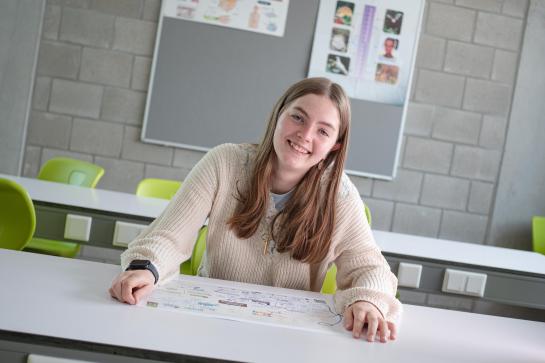 Liene Permentier van de MOS-leerlingenraad
 -
-
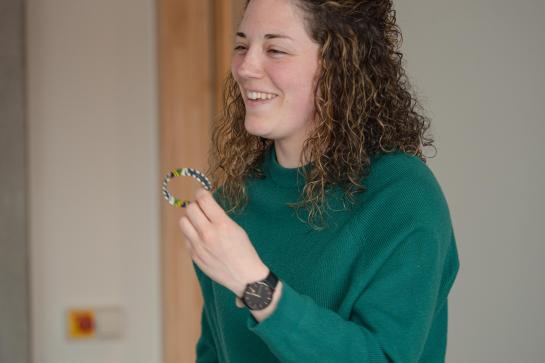 Sarah Coeckelbergh
 -
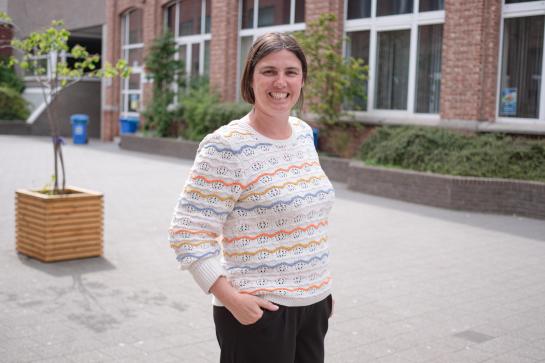 Barbara Van Baelen
 -
-
-
-